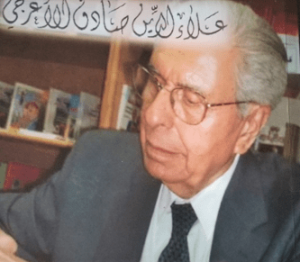
Aladdin Al-Araji
Dr. Alaa Araji
Introduction: If we had carefully looked at what was around us, with open minds, we would have found the world, or even the universe, changing at every moment. Behind this apparent stillness and immutable order, there are universes of explosive revolutions, manifested in the constant struggles or the continuous interactions between billions upon billions of opposing or mutually reinforcing forces.
In the human body, for example, as in the body of every living being, there is a fierce and continuous struggle between the forces of annihilation and the forces of survival. And in the vast universe there are billions of blazing radiant suns and billions of satellite planets, which remain in perpetual motion and continuous change. All of them are attracted or diverged from each other and from the center of the universe at great speeds. Even the deaf stone, which appears to us to be still, is raging inside it a great revolution and a mute change, for the ordinary beholder, and a stark change for the observant beholder, whether because of the interactions that take place between the moving atoms in it, or inside each atom of it, where another universe emerges in each of them. It involves multiple particles, which have continuous interactions and attractions. And all these events, the young and the great, lead to continuous development and change to the extent that it can be said: The present moment is different from the previous moment, just as it is different from the one to come, because everything in existence has changed and will change. What we are saying does not contain anything new. Heraclitus broadcast it 2,500 years ago, in his famous saying: “I cannot step into the same river twice, because when I take a bath the second time the river has changed, and so have I.” Goethe said, “He who does not know how to learn the lessons of the past three thousand years remains in the dark.”
If this is the matter of life and matter, then what about society, whose parts consist of the gathering of some human beings to form a cooperating entity to achieve survival? Shouldn’t it evolve? Also, history itself bears witness to this change and development, and rather proves it in every period of time. Is social, intellectual and material life today similar to life a thousand years ago, or even fifty years ago, for example? What’s more, no doubt everyone notices how the world has changed since the events of September 11, 2001!!
And when people change, including ourselves of course, and thus society and the private and public environment, our view of everything changes, including our view of history itself, and from this very simple fact, and extremely dangerous, our theory of the importance of rewriting history can start. The Arab Islamic in addition to the other reasons listed below and in the next episode.
* * *
This research attempts to propose a comprehensive project to rewrite the Arab-Islamic history, with specific scientific and critical conditions. To prepare for the realization of some of this broad and long-term goal, we will try to define the concepts and terminology very initially, in the first episode, and then we will explain some of the reasons that call for the realization of this project, in the second episode.
We will not claim that we will fulfill this subject’s right, through this brief research. However, we content ourselves with putting it on the table as a crude proposal that needs to be matured and expanded through a broader and more accurate study by researchers specialized in various related fields.
Thus, we will suffice with providing a quick overview of the importance of rewriting Arab-Islamic history, and thus reconsidering the heritage itself, as an attempt to create a degree of mature historical awareness among most members of society, among whom are many educated and intellectuals.
However, we cannot promise the readers that what we have said, and what we will say, is exactly right, but rather it is just a humble opinion, subject to the readers’ criticism, which the writer welcomes with pleasure and gratitude, because it may enrich or modify the research, to be more useful and feasible.
Defining some concepts
Note: We define our research in “human history” in particular, that is, we exclude, for example, the natural history related to animals and plants, the history of the layers of the earth, the history of the universe and the planets, and other dates.
Definitions of human history are many and complex. We review some of them very briefly:
Linguistically: From the verb “to date”, the book specified its date, and it chronicled the incident and the like: He detailed its history and specified its time. And the history of nations and others (and the hamza is facilitated), mentioning its origin, development and effects. (“The Median, Chronicle Material”). The word may be southern Arabic, depending on a narration that says that the first person to date history was “Ya’li ibn Umayyah” when he was in Yemen. So he wrote to Caliph Omar a dated book. Omar approved it and said, “This is good, so let it go.” The orientalist HAR Gibb believes that the word “date” is derived from the ancient Semitic language, which means the moon or the month.
Idiomatically: Ibn Khaldun says that history “is an art that is circulated by nations and generations, and riders and travelers are drawn to it … as it is in its appearance no more than telling about days and countries, and precedents from the first centuries … and leads us to the matter of creation, how conditions fluctuated in it, and expanded to countries It has scope and scope, and they inhabited the earth until migration called for them, and it was time for them to disappear, and in its interior there is a look and investigation, an explanation of beings and their principles is accurate, and knowledge of the modalities of events and their causes is deep, so it is therefore original in wisdom, ancient, and worthy of being counted in its sciences and morals. Thus, Ibn Khaldun opened the gate of “the science of history”, in the modern sense, for the first time.
The word history for Socrates denotes knowledge, and for Aristotle the collection of documents. And according to Bacon, it is “the search for the conditions of human history and their past events.” The word history in the modern era refers to “knowledge of the various conditions that followed successively on something in the past, whether that thing was material or intangible: such as the history of the people, the history of the family, the history of the judiciary, the history of science, the history of philosophy, etc. . .”
Constantine Zurayk defines history as “the quest to understand and revive the human past.” Then he elaborates and elaborates on this definition, and even justifies, to a large extent, indirectly, our call to rewrite Arab-Islamic history.
Raymond Aron defines it, in his book “An Introduction to the Philosophy of History,” in its narrow sense, as “the science of the human past.” In its broadest sense, he says, it means “the study of the process of le devenir, the earth, the sky, and the human races, in addition to civilization.” (6)
We suggest that we distinguish between the concept of the word “history” as referring once to the human past itself, and at other times to the effort to know that past or the science concerned with this subject. Some French researchers have tried to distinguish between the two concepts, by making the word histoire written with the capital letter H, to denote the past, while histoire denotes the science concerned with history.
* * *
We also see, contrary to the definition contained in the “intermediate dictionary” which does not differentiate between “history” and “history” (in hams), that we must differentiate between the two terms. The first is a “name” given to a name related to a past or origin, so it says the history of Europe or the history of the Arab nation, that is, the conditions that Europe or the Arab nation were in in its past, near or far, or defining and separating its origin. As for the word “history” (in a whisper) of Europe or the history of the Arab nation, it is a “source” and means the process of making “history” related to them, with all that it contains of research in documents, study of antiquities, investigation and criticism. It also means specifying the time or time of the event, so you say, for example, the date of the message or the book or the date of the document or the historical trace, i.e. the process of determining the time of the trace or the issuance of the message or book.
Thus, we suggest that we distinguish, perhaps unlike many well-known historians, as far as we know, between four meanings of the word history, instead of just two meanings:
The first is the well-known history, as news about the past, with a greater or lesser degree of accuracy and detail (the news itself, or written, or hypothesized, or extracted from the discovered antiquities).
The second is history itself, that is, the facts and events as they actually occurred. All indications point to the inability to know the conditions of the past, the farther it is. Most of the news of the past is lost or not transmitted completely or with the necessary accuracy, because it is deduced with a great deal of guesswork and little confidence. And if we want accuracy, we do not really know what exactly happened yesterday or today in our world, but rather in our city, especially if it is a big city, despite the development of the means of communication, let alone what actually happened thousands of years ago or more! ! We do not mean, of course, everything that happens to individuals in terms of ordinary, familiar daily affairs, but rather important events that include certain societal connotations, or that can lead to important results. However, these familiar, everyday events can constitute fertile material for historical and sociological studies, especially after a certain period of time has passed. For example, we are very interested today in finding a 3,000-year-old clay “inscription” documenting an ordinary deal to sell wheat output in the field of “A” people to “B” people, at the site of the city of “Ur”, in the south of the country. Iraq. This is because we derive from the study of these documents, which were considered normal in their time, results that shed light on commercial and social relations, and the way of life and dealings of people at that time. Especially since ancient historians were not used to talking about the lifestyles of ordinary people, while modern historical approaches used to study the conditions of societies, by tracking the news of their members and their interacting relationships.
And the third is history (in hamzah), which is the “process” of studying history, as we mentioned above. We say, for example, that we seek to rewrite the “Arab-Islamic history” through the “history” of it. That is, through what we do of various “operations and procedures” to extract historical facts, including research in reliable sources and excavations in private and buried antiquities, etc. . . . That is why it is correct to say, for example, “we do the history of history” (the first with the hamzah and the second without it), that is, we chronicle the history itself, so we study how and when historical studies began and the processes of codifying history or scrutinizing its facts took place, and how those studies developed, as well as studying the means Historical research that led to the discovery of the history of this or that society.
The fourth is the designation given to written works related to the codification of history. For example, we say: The History of al-Tabari, and by it we mean the book “History of Nations and Kings,” which was written by Muhammad bin Jarir al-Tabari. As we say the history of al-Masoudi, we mean the book “Promoter of Gold and Metals of Essence” by Abi al-Hussein Ali al-Masoudi, or the history of al-Jabarti, to mean “the history of the wonders of archeology in translations and news” by its author Abd al-Rahman al-Jabarti, and so on.
Commenting on the first and second meanings, we see that an event does not become a historical event unless it is known, and it is not known unless it is witnessed, then transmitted orally or in writing, and thus turns into a historical event. However, behind every event that is reported orally or in writing, there are hundreds or even thousands of large or small events that were not reported. These hidden events increase as we move away from the present time. This is not because of its insignificance or seriousness, as we mentioned above, but rather because it was not witnessed in the first place, or it was witnessed and was not written down, or it was witnessed and written down, but its document was lost. Thus, the history that we read represents, most likely, a small part of the historical truth that actually took place, or a part of a distorted or modified reality. In this context, Abdullah Al-Aroui says: “Every event becomes an event when it is described, even for the contemporary, the viewer of it. It is not possible to imagine a description that fully matches reality.
On the other hand – and we are still in the framework of analyzing or dismantling the first and second definitions – the historical news is related to the historian, the reporter of the news, or the journalist. Each of them is a human being who is affected by him and his circumstances as an event, and his own personal circumstances, to different degrees and manners. It can also be conveyed in different forms that affect its content or significance. Therefore, the contemporary historian in general, and the Arab historian in particular, has a great responsibility in investigating, scrutinizing, comparing and criticizing the various texts. Rather, he investigates the historian’s intention, apparent or hidden, or his source in conveying the news, as well as his tendencies, tendencies and beliefs, to discover the extent of his objectivity and uniqueness, and thus, discover what can be He could have consciously or unconsciously neglected him.
As an example, we refer to a specific point in the history book known as “The Conquests of Countries” by Al-Baladhuri. This is because this historian’s close links with the Abbasid caliphs and their ministers influenced his writing of the well-known history of that era. He praised al-Ma’mun and became one of al-Mutawakkil’s close associates and approached al-Musta’in and al-Mu’tazz, who entrusted him with educating his son, as Yaqut al-Hamawi indicates in his “Dictionary of Countries.” Thus, although he was contemporary with the “Babiki” revolution, with its progressive principles (abolishing land ownership and distributing it to peasants, emancipating women, etc.), which are principles that completely contradict the interests of the ruling class in the Abbasid caliphate, so I fought it for 22 years; I say that although Al-Baladhuri lived through this revolution from his youth, he neglected it almost throughout his history, and he only referred to it in a short, fleeting way, and called its leader “the infidel Khurami”, and that was an act of rapprochement with the Abbasids.
In order to further demonstrate the importance and seriousness of the news reporter’s interference (considering that the news is the raw raw material that constitutes the historian’s information) in the reality of the event itself, we can bring many examples related to the method of transmitting news in the modern era, which is supposed to be the most frank, credible, accurate and objective era. Based on the availability of material and technical capabilities, the shortening of distances, and the convergence of the corners of the globe, which has become described as a small village. But we suffice with giving one example, in which we recall the differences, sometimes small or large, between the method of transmitting the news by the “Al-Jazeera” satellite channel in Qatar, and transmitting it by the “CNN” station or the “Fox N” station, the two Americas. Especially if the news is related to the issue of the Arab-Israeli conflict and the Arab region in general. Here, political, ideological and interest differences intervene between the two parties reporting the news. This is what often happens.
Also in the same context, the Iraqi poet and historian Marouf Al-Rusafi goes to the limit, saying that after he “was writing about history, taking it into account and making it a status. . . “He deserves it, the days have ripened him with their accidents, so they have transformed him from one state to another.” And he adds: “Thus, the days did to me until I became not giving weight to history and not taking an account of it because I saw it as the house of lies and the climate of delusion and the whims of people. In it, there are not (in it) tiny atoms of the fragments of truth, so it is impossible or difficult for one to extract from the pool of his falsehoods the atoms of the fragments of truth. He expressed this in a long poem titled “The Misguidance of History” (with the Conquest), in which he said:
History was not written in all that it narrated to its readers
except a fabricated hadith.
And no eyes believe us in the facts, so how then does Muhariq believe in them?
And has He singled us out from those who died before us with wickedness of attributes? Too much to be fooled
(Al-Muharraq, in the passive form, the sahifah, i.e. the historical text)
and this last point in particular, even if it is exaggerated in its sylphic description, constitutes one of the important reasons that justify the call to rewrite Arab-Islamic history, and it also brings us to the following question:
What do we mean by rewriting Arab Islamic history?
By rewriting that history, in our research, we mean seeking to reconsider and explore the past of the Arab-Islamic society, in its various manifestations, developments and circumstances, and the relationships of those manifestations to each other, in order to realize and understand that past, not as we imagine it was or as it ought to be, or As we hope it will be, or as it was reported by Arab or foreign historians; Rather, in order to seek to understand it, or to get close to it, as it really was, as much as possible. Or rather, by that we mean looking at our past with our eyes, the living, not with the eyes of the dead, who died hundreds of years ago or more. That we try to do so by using the best modern research and critical methods, to delve into the deepest depths of the past and all of them, as much as possible, in order to reach the most likely facts related to events, things and people, prominent, ordinary or marginalized, and their living and environmental conditions, natural, social, political and economic, and their relations among themselves. others, or their relations with their rulers and presidents, etc. . .
Here, we emphasize the importance of studying the marginalized or neglected periods of Arab Islamic history.
Among the important periods that deserve attention and analysis, we mention the period that preceded the emergence of Islam, in which ancient Islamic historical studies were not sufficiently concerned, nor were they viewed objectively. This period is referred to in the Holy Qur’an, where it is called the “ignorance” (“Do they want to rule in ignorance” al-Ma’idah 50). This is because the emergence of Islam is considered a revolution against the concepts, values and standards of that “pre-Islamic” era. By this capacity, in addition to ignorance, he means political and social chaos, due to the lack of a central authority.
However, this does not prevent the study of that period, but rather confirms the need to study it more carefully, because we see that some of the roots of the “contemporary Arab societal mind” lie in it, to a large extent. Rather, we offered an opinion that the Arabs still adhered to many pre-Islamic values, especially the tribal (Bedouin), against which Islam fought. Among the manifestations that support this view is the prevailing social structure in most Arab countries, especially in the Gulf countries, as well as the conflict that exists in Iraq today between Sunnis and Shiites, whose roots go back far and deep, in our opinion, to a tribal conflict, between the Hashemites and the Umayyads, that existed Before Islam, it was manifested after the death of the Prophet in the struggle for succession, especially after the killing of Caliph Uthman. Dr. Taha Hussein called this struggle the “great sedition.”
This tribal conflict, whose origins go back more than fourteen centuries, and which resulted in the civil war that broke out in Iraq, threatens to break out into other conflicts and perhaps civil wars (Lebanon), that could lead to the intervention of neighboring countries, which might result in igniting the region. , originally worried, in its entirety.
In this context, we put forward, in our book “The Crisis of Civilizational Development in the Arab World,” the hypothesis that the Arabs did not go through the stage of agriculture sufficiently to erase the Bedouin values that prevailed, to a large extent, in the pre-Islamic era. We have explained the importance of going through this stage, and why the Arabs in general failed to go through it, in a number of complementary studies.
In the context of what is meant by re-examining Arab-Islamic history as well, we see the importance of studying the last dark period that lasted for nearly six centuries. With the availability of some important studies in the history of the Arabs before Islam, (such as the book of Dr. Jawad Ali, the encyclopedic), but studies related to the period of decline are almost rare, as far as I know. While we consider this period to be of great influence in the formation of the contemporary “Arab societal mind”. This is because we see that the contemporary Arabs are not the heirs of the Arab-Islamic civilization, as much as they are the heirs of this last age of decadence, because they are directly related to it, since it is the closest to them and the most effective in their minds and being. Thus, the currently dominant Arab “societal mind” is primarily affected by the era of decadence. This societal mind that imposed on the average individual what we called the “passive mind” on him, that is, the societal mind that is passive. Thus, we became imitators, not creators, of either the ancestors or the “last.”
However, we say that some of the points mentioned above overlap with the reasons for rewriting Arab-Islamic history, which we will discuss in detail in the next episode.
In recognition of the credit, we must finally refer to some attempts that partially contributed to the reconsideration of Arab Islamic history, in general. We mention, for example, the distinguished individual work done by Professor Ahmed Amin in his historical encyclopedia: “The dawn of Islam, the sacrifice of Islam, and the emergence of Islam.” We also acknowledge the valuable effort made by the thinker Muhammad Abed Al-Jabri, in his series of works related to heritage and modernity, and his quartet in “Critique of the Arab Reason” (Formation of the Arab Mind, The Structure of the Arab Mind, the Arab Political Reason, the Arab Ethical Mind). We will also not overlook the series of books by Hassan Hanafi (from belief to revolution, for example), and the series of works by Muhammad Arkoun, in the study and analysis of Arab-Islamic history, and the collection of “Concepts” by Abdullah Al-Aroui, and Burhan Al-Din Dalou, in his book “Contribution to Rewriting Arab-Islamic History.” , and others. Taha Hussein also provides us with an example worthy of consideration, with regard to historical criticism, in his book “On Pre-Islamic Poetry.”
We also particularly commend the great work accomplished by the Iraqi historian Jawad Ali, in his distinguished book “Al-Mufassal fi Tarikh al-Arab before Islam”, in ten huge volumes.
With our appreciation for the various attempts that deal with Arab-Islamic history with great efficiency at times, all these valuable individual studies do not amount to what we call for. Especially since these studies deal with only certain aspects of Arab-Islamic history. It also stems from, for the most part, the historical works that Muslim historians developed in the codification era, which began in the middle of the second Hijri century, and these works must themselves be subject to criticism and scrutiny, because they were written with the mentality of that time and were subject to its political conditions and social obligations. On the other hand, most of these recent studies avoid entering into a discussion of sensitive issues related to the doctrinal history of Islam. For known reasons. Few researchers also address the issue of criticism of texts and documents, including antiquities and figures that have been discovered, or that still need to be researched and explored, especially in many areas of the Arabian Peninsula, which are still almost untouched.
Thus, our aim in this research is to call for the establishment of organized collective action, to be carried out by a team of Arab intellectuals and specialists inside and/or outside the Arab world. With our reservations about the difficulty of applying this in a society full of formal, moral and ethical restrictions, i.e. the necessities of the “societal mind” and its firm doctrinal postulates, which impede the free historian’s aspirations to discover facts, no matter how harsh they may be, and prevent the use of “active reason”, instead of submitting to “passive reason”. . And if it is possible to overcome these obstacles, this team can achieve the following:
First, agree on laying down the rules of research methods, which are the most followed or considered, to determine the procedures for research, excavation, criticism of historical texts and available antiquities, and their interpretation.
Secondly, within the framework of the criticism and interpretation of historical texts, the team undertakes an interrogation of the available texts to explore what is behind the apparent meaning of the text or the meaning that is silent about it, which in turn indicates a deeper and more significant meaning and perhaps more mature “facts”. It is certain that these “facts” will remain the subject of discussion and differing opinions, yet their availability to the reader and researcher constitutes a great intellectual wealth.
Thirdly, a comprehensive and integrated documented history of four main periods: the pre-Islamic period, the period of the emergence of Islam and the Arab-Islamic civilization, the dark period, and the period of the Arab renaissance during the last two centuries. This history will constitute a rich inclusive reference for scholars: professors, thinkers, students and researchers.
This team will need, I think, to make an inventory of all or most of the published historical texts related to Arab-Islamic history, in various languages. Perhaps it will also need to be supplemented by the many unprinted Arabic manuscripts scattered around the world. Which is still waiting to come out. In particular, we emphasize those photographed and documented by the “Arab Manuscripts Institute” affiliated to the “Arab Organization for Education, Culture and Science,” as well as other manuscripts estimated by Dr. Khaled Azab at three million manuscripts, spread in many public and private libraries, mosques, and cultural institutions. We also refer, with regret, to the precious archives and manuscripts that were present in the “Iraqi Documents House”, including the Iraqi Museum Library, the National Library and the Iraqi Scientific Academy Library, which were looted and burned after the occupation of Baghdad in 2003.
Returning to the issue of rewriting Arab-Islamic history, we note with interest that the thinker Muhammad Abed Al-Jabri has long ago, through his numerous writings on heritage, modernity, criticism of the Arab mind, and others, called for the inauguration of a new era of codification, similar to the era of Arab-Islamic codification that began In the middle of the second Hijri century, which established the pillars and lists of the Arab mind until the modern era. He also called for rewriting Arab and Islamic history, in the same framework. We will briefly talk about his opinion on this point in the second episode.
a summary
In the introduction to this episode, we discussed the importance of being aware of change and development, based on what we observe and feel of the rapid changes taking place in the world, especially in terms of scientific, technological and economic progress, and the changes that follow on the social and intellectual levels. As these changes continue and increase in speed and pace, we Arabs find ourselves in a state of stagnation or stagnation, or rather in a state of regression to the past, on which we rely, to justify our inability to keep pace with the rising civilized march. Therefore, our view of history has not changed because of this inertia. Thus we find ourselves in the middle of a vicious circle. Stagnation leads to a rigid view of everything, including our history. This rigid view leads to an increase in our rigidity, and thus our backwardness.
As a modest attempt to dissolve or break this cycle (the role), we saw that Arab intellectuals should begin, among other things, by reconsidering our concept of history in general, by reconsidering our history, with our eyes, the living, and not with the eyes of the dead. This is a prelude to creating a historical awareness among the general public, and thus changing their rigid view of history, in order to move these static, even stagnant, waters, and turn them into flowing streams and roaring waterfalls.
Thus, we embarked on this research by defining the concept of history, its multiple definitions, and its four concepts, and then we stopped by to explain what we mean by rewriting Arab-Islamic history. In the next episode, we will detail the most important reasons that call us to reconsider this date.
Aladdin Al-Araji
Dr. Alaa Araji
Introduction: If we had carefully looked at what was around us, with open minds, we would have found the world, or even the universe, changing at every moment. Behind this apparent stillness and immutable order, there are universes of explosive revolutions, manifested in the constant struggles or the continuous interactions between billions upon billions of opposing or mutually reinforcing forces.
In the human body, for example, as in the body of every living being, there is a fierce and continuous struggle between the forces of annihilation and the forces of survival. And in the vast universe there are billions of blazing radiant suns and billions of satellite planets, which remain in perpetual motion and continuous change. All of them are attracted or diverged from each other and from the center of the universe at great speeds. Even the deaf stone, which appears to us to be still, is raging inside it a great revolution and a mute change, for the ordinary beholder, and a stark change for the observant beholder, whether because of the interactions that take place between the moving atoms in it, or inside each atom of it, where another universe emerges in each of them. It involves multiple particles, which have continuous interactions and attractions. And all these events, the young and the great, lead to continuous development and change to the extent that it can be said: The present moment is different from the previous moment, just as it is different from the one to come, because everything in existence has changed and will change. What we are saying does not contain anything new. Heraclitus broadcast it 2,500 years ago, in his famous saying: “I cannot step into the same river twice, because when I take a bath the second time the river has changed, and so have I.” Goethe said, “He who does not know how to learn the lessons of the past three thousand years remains in the dark.”
If this is the matter of life and matter, then what about society, whose parts consist of the gathering of some human beings to form a cooperating entity to achieve survival? Shouldn’t it evolve? Also, history itself bears witness to this change and development, and rather proves it in every period of time. Is social, intellectual and material life today similar to life a thousand years ago, or even fifty years ago, for example? What’s more, no doubt everyone notices how the world has changed since the events of September 11, 2001!!
And when people change, including ourselves of course, and thus society and the private and public environment, our view of everything changes, including our view of history itself, and from this very simple fact, and extremely dangerous, our theory of the importance of rewriting history can start. The Arab Islamic in addition to the other reasons listed below and in the next episode.
* * *
This research attempts to propose a comprehensive project to rewrite the Arab-Islamic history, with specific scientific and critical conditions. To prepare for the realization of some of this broad and long-term goal, we will try to define the concepts and terminology very initially, in the first episode, and then we will explain some of the reasons that call for the realization of this project, in the second episode.
We will not claim that we will fulfill this subject’s right, through this brief research. However, we content ourselves with putting it on the table as a crude proposal that needs to be matured and expanded through a broader and more accurate study by researchers specialized in various related fields.
Thus, we will suffice with providing a quick overview of the importance of rewriting Arab-Islamic history, and thus reconsidering the heritage itself, as an attempt to create a degree of mature historical awareness among most members of society, among whom are many educated and intellectuals.
However, we cannot promise the readers that what we have said, and what we will say, is exactly right, but rather it is just a humble opinion, subject to the readers’ criticism, which the writer welcomes with pleasure and gratitude, because it may enrich or modify the research, to be more useful and feasible.
Defining some concepts
Note: We define our research in “human history” in particular, that is, we exclude, for example, the natural history related to animals and plants, the history of the layers of the earth, the history of the universe and the planets, and other dates.
Definitions of human history are many and complex. We review some of them very briefly:
Linguistically: From the verb “to date”, the book specified its date, and it chronicled the incident and the like: He detailed its history and specified its time. And the history of nations and others (and the hamza is facilitated), mentioning its origin, development and effects. (“The Median, Chronicle Material”). The word may be southern Arabic, depending on a narration that says that the first person to date history was “Ya’li ibn Umayyah” when he was in Yemen. So he wrote to Caliph Omar a dated book. Omar approved it and said, “This is good, so let it go.” The orientalist HAR Gibb believes that the word “date” is derived from the ancient Semitic language, which means the moon or the month.
Idiomatically: Ibn Khaldun says that history “is an art that is circulated by nations and generations, and riders and travelers are drawn to it … as it is in its appearance no more than telling about days and countries, and precedents from the first centuries … and leads us to the matter of creation, how conditions fluctuated in it, and expanded to countries It has scope and scope, and they inhabited the earth until migration called for them, and it was time for them to disappear, and in its interior there is a look and investigation, an explanation of beings and their principles is accurate, and knowledge of the modalities of events and their causes is deep, so it is therefore original in wisdom, ancient, and worthy of being counted in its sciences and morals. Thus, Ibn Khaldun opened the gate of “the science of history”, in the modern sense, for the first time.
The word history for Socrates denotes knowledge, and for Aristotle the collection of documents. And according to Bacon, it is “the search for the conditions of human history and their past events.” The word history in the modern era refers to “knowledge of the various conditions that followed successively on something in the past, whether that thing was material or intangible: such as the history of the people, the history of the family, the history of the judiciary, the history of science, the history of philosophy, etc. . .”
Constantine Zurayk defines history as “the quest to understand and revive the human past.” Then he elaborates and elaborates on this definition, and even justifies, to a large extent, indirectly, our call to rewrite Arab-Islamic history.
Raymond Aron defines it, in his book “An Introduction to the Philosophy of History,” in its narrow sense, as “the science of the human past.” In its broadest sense, he says, it means “the study of the process of le devenir, the earth, the sky, and the human races, in addition to civilization.” (6)
We suggest that we distinguish between the concept of the word “history” as referring once to the human past itself, and at other times to the effort to know that past or the science concerned with this subject. Some French researchers have tried to distinguish between the two concepts, by making the word histoire written with the capital letter H, to denote the past, while histoire denotes the science concerned with history.
* * *
We also see, contrary to the definition contained in the “intermediate dictionary” which does not differentiate between “history” and “history” (in hams), that we must differentiate between the two terms. The first is a “name” given to a name related to a past or origin, so it says the history of Europe or the history of the Arab nation, that is, the conditions that Europe or the Arab nation were in in its past, near or far, or defining and separating its origin. As for the word “history” (in a whisper) of Europe or the history of the Arab nation, it is a “source” and means the process of making “history” related to them, with all that it contains of research in documents, study of antiquities, investigation and criticism. It also means specifying the time or time of the event, so you say, for example, the date of the message or the book or the date of the document or the historical trace, i.e. the process of determining the time of the trace or the issuance of the message or book.
Thus, we suggest that we distinguish, perhaps unlike many well-known historians, as far as we know, between four meanings of the word history, instead of just two meanings:
The first is the well-known history, as news about the past, with a greater or lesser degree of accuracy and detail (the news itself, or written, or hypothesized, or extracted from the discovered antiquities).
The second is history itself, that is, the facts and events as they actually occurred. All indications point to the inability to know the conditions of the past, the farther it is. Most of the news of the past is lost or not transmitted completely or with the necessary accuracy, because it is deduced with a great deal of guesswork and little confidence. And if we want accuracy, we do not really know what exactly happened yesterday or today in our world, but rather in our city, especially if it is a big city, despite the development of the means of communication, let alone what actually happened thousands of years ago or more! ! We do not mean, of course, everything that happens to individuals in terms of ordinary, familiar daily affairs, but rather important events that include certain societal connotations, or that can lead to important results. However, these familiar, everyday events can constitute fertile material for historical and sociological studies, especially after a certain period of time has passed. For example, we are very interested today in finding a 3,000-year-old clay “inscription” documenting an ordinary deal to sell wheat output in the field of “A” people to “B” people, at the site of the city of “Ur”, in the south of the country. Iraq. This is because we derive from the study of these documents, which were considered normal in their time, results that shed light on commercial and social relations, and the way of life and dealings of people at that time. Especially since ancient historians were not used to talking about the lifestyles of ordinary people, while modern historical approaches used to study the conditions of societies, by tracking the news of their members and their interacting relationships.
And the third is history (in hamzah), which is the “process” of studying history, as we mentioned above. We say, for example, that we seek to rewrite the “Arab-Islamic history” through the “history” of it. That is, through what we do of various “operations and procedures” to extract historical facts, including research in reliable sources and excavations in private and buried antiquities, etc. . . . That is why it is correct to say, for example, “we do the history of history” (the first with the hamzah and the second without it), that is, we chronicle the history itself, so we study how and when historical studies began and the processes of codifying history or scrutinizing its facts took place, and how those studies developed, as well as studying the means Historical research that led to the discovery of the history of this or that society.
The fourth is the designation given to written works related to the codification of history. For example, we say: The History of al-Tabari, and by it we mean the book “History of Nations and Kings,” which was written by Muhammad bin Jarir al-Tabari. As we say the history of al-Masoudi, we mean the book “Promoter of Gold and Metals of Essence” by Abi al-Hussein Ali al-Masoudi, or the history of al-Jabarti, to mean “the history of the wonders of archeology in translations and news” by its author Abd al-Rahman al-Jabarti, and so on.
Commenting on the first and second meanings, we see that an event does not become a historical event unless it is known, and it is not known unless it is witnessed, then transmitted orally or in writing, and thus turns into a historical event. However, behind every event that is reported orally or in writing, there are hundreds or even thousands of large or small events that were not reported. These hidden events increase as we move away from the present time. This is not because of its insignificance or seriousness, as we mentioned above, but rather because it was not witnessed in the first place, or it was witnessed and was not written down, or it was witnessed and written down, but its document was lost. Thus, the history that we read represents, most likely, a small part of the historical truth that actually took place, or a part of a distorted or modified reality. In this context, Abdullah Al-Aroui says: “Every event becomes an event when it is described, even for the contemporary, the viewer of it. It is not possible to imagine a description that fully matches reality.
On the other hand – and we are still in the framework of analyzing or dismantling the first and second definitions – the historical news is related to the historian, the reporter of the news, or the journalist. Each of them is a human being who is affected by him and his circumstances as an event, and his own personal circumstances, to different degrees and manners. It can also be conveyed in different forms that affect its content or significance. Therefore, the contemporary historian in general, and the Arab historian in particular, has a great responsibility in investigating, scrutinizing, comparing and criticizing the various texts. Rather, he investigates the historian’s intention, apparent or hidden, or his source in conveying the news, as well as his tendencies, tendencies and beliefs, to discover the extent of his objectivity and uniqueness, and thus, discover what can be He could have consciously or unconsciously neglected him.
As an example, we refer to a specific point in the history book known as “The Conquests of Countries” by Al-Baladhuri. This is because this historian’s close links with the Abbasid caliphs and their ministers influenced his writing of the well-known history of that era. He praised al-Ma’mun and became one of al-Mutawakkil’s close associates and approached al-Musta’in and al-Mu’tazz, who entrusted him with educating his son, as Yaqut al-Hamawi indicates in his “Dictionary of Countries.” Thus, although he was contemporary with the “Babiki” revolution, with its progressive principles (abolishing land ownership and distributing it to peasants, emancipating women, etc.), which are principles that completely contradict the interests of the ruling class in the Abbasid caliphate, so I fought it for 22 years; I say that although Al-Baladhuri lived through this revolution from his youth, he neglected it almost throughout his history, and he only referred to it in a short, fleeting way, and called its leader “the infidel Khurami”, and that was an act of rapprochement with the Abbasids.
In order to further demonstrate the importance and seriousness of the news reporter’s interference (considering that the news is the raw raw material that constitutes the historian’s information) in the reality of the event itself, we can bring many examples related to the method of transmitting news in the modern era, which is supposed to be the most frank, credible, accurate and objective era. Based on the availability of material and technical capabilities, the shortening of distances, and the convergence of the corners of the globe, which has become described as a small village. But we suffice with giving one example, in which we recall the differences, sometimes small or large, between the method of transmitting the news by the “Al-Jazeera” satellite channel in Qatar, and transmitting it by the “CNN” station or the “Fox N” station, the two Americas. Especially if the news is related to the issue of the Arab-Israeli conflict and the Arab region in general. Here, political, ideological and interest differences intervene between the two parties reporting the news. This is what often happens.
Also in the same context, the Iraqi poet and historian Marouf Al-Rusafi goes to the limit, saying that after he “was writing about history, taking it into account and making it a status. . . “He deserves it, the days have ripened him with their accidents, so they have transformed him from one state to another.” And he adds: “Thus, the days did to me until I became not giving weight to history and not taking an account of it because I saw it as the house of lies and the climate of delusion and the whims of people. In it, there are not (in it) tiny atoms of the fragments of truth, so it is impossible or difficult for one to extract from the pool of his falsehoods the atoms of the fragments of truth. He expressed this in a long poem titled “The Misguidance of History” (with the Conquest), in which he said:
History was not written in all that it narrated to its readers
except a fabricated hadith.
And no eyes believe us in the facts, so how then does Muhariq believe in them?
And has He singled us out from those who died before us with wickedness of attributes? Too much to be fooled
(Al-Muharraq, in the passive form, the sahifah, i.e. the historical text)
and this last point in particular, even if it is exaggerated in its sylphic description, constitutes one of the important reasons that justify the call to rewrite Arab-Islamic history, and it also brings us to the following question:
What do we mean by rewriting Arab Islamic history?
By rewriting that history, in our research, we mean seeking to reconsider and explore the past of the Arab-Islamic society, in its various manifestations, developments and circumstances, and the relationships of those manifestations to each other, in order to realize and understand that past, not as we imagine it was or as it ought to be, or As we hope it will be, or as it was reported by Arab or foreign historians; Rather, in order to seek to understand it, or to get close to it, as it really was, as much as possible. Or rather, by that we mean looking at our past with our eyes, the living, not with the eyes of the dead, who died hundreds of years ago or more. That we try to do so by using the best modern research and critical methods, to delve into the deepest depths of the past and all of them, as much as possible, in order to reach the most likely facts related to events, things and people, prominent, ordinary or marginalized, and their living and environmental conditions, natural, social, political and economic, and their relations among themselves. others, or their relations with their rulers and presidents, etc. . .
Here, we emphasize the importance of studying the marginalized or neglected periods of Arab Islamic history.
Among the important periods that deserve attention and analysis, we mention the period that preceded the emergence of Islam, in which ancient Islamic historical studies were not sufficiently concerned, nor were they viewed objectively. This period is referred to in the Holy Qur’an, where it is called the “ignorance” (“Do they want to rule in ignorance” al-Ma’idah 50). This is because the emergence of Islam is considered a revolution against the concepts, values and standards of that “pre-Islamic” era. By this capacity, in addition to ignorance, he means political and social chaos, due to the lack of a central authority.
However, this does not prevent the study of that period, but rather confirms the need to study it more carefully, because we see that some of the roots of the “contemporary Arab societal mind” lie in it, to a large extent. Rather, we offered an opinion that the Arabs still adhered to many pre-Islamic values, especially the tribal (Bedouin), against which Islam fought. Among the manifestations that support this view is the prevailing social structure in most Arab countries, especially in the Gulf countries, as well as the conflict that exists in Iraq today between Sunnis and Shiites, whose roots go back far and deep, in our opinion, to a tribal conflict, between the Hashemites and the Umayyads, that existed Before Islam, it was manifested after the death of the Prophet in the struggle for succession, especially after the killing of Caliph Uthman. Dr. Taha Hussein called this struggle the “great sedition.”
This tribal conflict, whose origins go back more than fourteen centuries, and which resulted in the civil war that broke out in Iraq, threatens to break out into other conflicts and perhaps civil wars (Lebanon), that could lead to the intervention of neighboring countries, which might result in igniting the region. , originally worried, in its entirety.
In this context, we put forward, in our book “The Crisis of Civilizational Development in the Arab World,” the hypothesis that the Arabs did not go through the stage of agriculture sufficiently to erase the Bedouin values that prevailed, to a large extent, in the pre-Islamic era. We have explained the importance of going through this stage, and why the Arabs in general failed to go through it, in a number of complementary studies.
In the context of what is meant by re-examining Arab-Islamic history as well, we see the importance of studying the last dark period that lasted for nearly six centuries. With the availability of some important studies in the history of the Arabs before Islam, (such as the book of Dr. Jawad Ali, the encyclopedic), but studies related to the period of decline are almost rare, as far as I know. While we consider this period to be of great influence in the formation of the contemporary “Arab societal mind”. This is because we see that the contemporary Arabs are not the heirs of the Arab-Islamic civilization, as much as they are the heirs of this last age of decadence, because they are directly related to it, since it is the closest to them and the most effective in their minds and being. Thus, the currently dominant Arab “societal mind” is primarily affected by the era of decadence. This societal mind that imposed on the average individual what we called the “passive mind” on him, that is, the societal mind that is passive. Thus, we became imitators, not creators, of either the ancestors or the “last.”
However, we say that some of the points mentioned above overlap with the reasons for rewriting Arab-Islamic history, which we will discuss in detail in the next episode.
In recognition of the credit, we must finally refer to some attempts that partially contributed to the reconsideration of Arab Islamic history, in general. We mention, for example, the distinguished individual work done by Professor Ahmed Amin in his historical encyclopedia: “The dawn of Islam, the sacrifice of Islam, and the emergence of Islam.” We also acknowledge the valuable effort made by the thinker Muhammad Abed Al-Jabri, in his series of works related to heritage and modernity, and his quartet in “Critique of the Arab Reason” (Formation of the Arab Mind, The Structure of the Arab Mind, the Arab Political Reason, the Arab Ethical Mind). We will also not overlook the series of books by Hassan Hanafi (from belief to revolution, for example), and the series of works by Muhammad Arkoun, in the study and analysis of Arab-Islamic history, and the collection of “Concepts” by Abdullah Al-Aroui, and Burhan Al-Din Dalou, in his book “Contribution to Rewriting Arab-Islamic History.” , and others. Taha Hussein also provides us with an example worthy of consideration, with regard to historical criticism, in his book “On Pre-Islamic Poetry.”
We also particularly commend the great work accomplished by the Iraqi historian Jawad Ali, in his distinguished book “Al-Mufassal fi Tarikh al-Arab before Islam”, in ten huge volumes.
With our appreciation for the various attempts that deal with Arab-Islamic history with great efficiency at times, all these valuable individual studies do not amount to what we call for. Especially since these studies deal with only certain aspects of Arab-Islamic history. It also stems from, for the most part, the historical works that Muslim historians developed in the codification era, which began in the middle of the second Hijri century, and these works must themselves be subject to criticism and scrutiny, because they were written with the mentality of that time and were subject to its political conditions and social obligations. On the other hand, most of these recent studies avoid entering into a discussion of sensitive issues related to the doctrinal history of Islam. For known reasons. Few researchers also address the issue of criticism of texts and documents, including antiquities and figures that have been discovered, or that still need to be researched and explored, especially in many areas of the Arabian Peninsula, which are still almost untouched.
Thus, our aim in this research is to call for the establishment of organized collective action, to be carried out by a team of Arab intellectuals and specialists inside and/or outside the Arab world. With our reservations about the difficulty of applying this in a society full of formal, moral and ethical restrictions, i.e. the necessities of the “societal mind” and its firm doctrinal postulates, which impede the free historian’s aspirations to discover facts, no matter how harsh they may be, and prevent the use of “active reason”, instead of submitting to “passive reason”. . And if it is possible to overcome these obstacles, this team can achieve the following:
First, agree on laying down the rules of research methods, which are the most followed or considered, to determine the procedures for research, excavation, criticism of historical texts and available antiquities, and their interpretation.
Secondly, within the framework of the criticism and interpretation of historical texts, the team undertakes an interrogation of the available texts to explore what is behind the apparent meaning of the text or the meaning that is silent about it, which in turn indicates a deeper and more significant meaning and perhaps more mature “facts”. It is certain that these “facts” will remain the subject of discussion and differing opinions, yet their availability to the reader and researcher constitutes a great intellectual wealth.
Thirdly, a comprehensive and integrated documented history of four main periods: the pre-Islamic period, the period of the emergence of Islam and the Arab-Islamic civilization, the dark period, and the period of the Arab renaissance during the last two centuries. This history will constitute a rich inclusive reference for scholars: professors, thinkers, students and researchers.
This team will need, I think, to make an inventory of all or most of the published historical texts related to Arab-Islamic history, in various languages. Perhaps it will also need to be supplemented by the many unprinted Arabic manuscripts scattered around the world. Which is still waiting to come out. In particular, we emphasize those photographed and documented by the “Arab Manuscripts Institute” affiliated to the “Arab Organization for Education, Culture and Science,” as well as other manuscripts estimated by Dr. Khaled Azab at three million manuscripts, spread in many public and private libraries, mosques, and cultural institutions. We also refer, with regret, to the precious archives and manuscripts that were present in the “Iraqi Documents House”, including the Iraqi Museum Library, the National Library and the Iraqi Scientific Academy Library, which were looted and burned after the occupation of Baghdad in 2003.
Returning to the issue of rewriting Arab-Islamic history, we note with interest that the thinker Muhammad Abed Al-Jabri has long ago, through his numerous writings on heritage, modernity, criticism of the Arab mind, and others, called for the inauguration of a new era of codification, similar to the era of Arab-Islamic codification that began In the middle of the second Hijri century, which established the pillars and lists of the Arab mind until the modern era. He also called for rewriting Arab and Islamic history, in the same framework. We will briefly talk about his opinion on this point in the second episode.
a summary
In the introduction to this episode, we discussed the importance of being aware of change and development, based on what we observe and feel of the rapid changes taking place in the world, especially in terms of scientific, technological and economic progress, and the changes that follow on the social and intellectual levels. As these changes continue and increase in speed and pace, we Arabs find ourselves in a state of stagnation or stagnation, or rather in a state of regression to the past, on which we rely, to justify our inability to keep pace with the rising civilized march. Therefore, our view of history has not changed because of this inertia. Thus we find ourselves in the middle of a vicious circle. Stagnation leads to a rigid view of everything, including our history. This rigid view leads to an increase in our rigidity, and thus our backwardness.
As a modest attempt to dissolve or break this cycle (the role), we saw that Arab intellectuals should begin, among other things, by reconsidering our concept of history in general, by reconsidering our history, with our eyes, the living, and not with the eyes of the dead. This is a prelude to creating a historical awareness among the general public, and thus changing their rigid view of history, in order to move these static, even stagnant, waters, and turn them into flowing streams and roaring waterfalls.
Thus, we embarked on this research by defining the concept of history, its multiple definitions, and its four concepts, and then we stopped by to explain what we mean by rewriting Arab-Islamic history. In the next episode, we will detail the most important reasons that call us to reconsider this date.