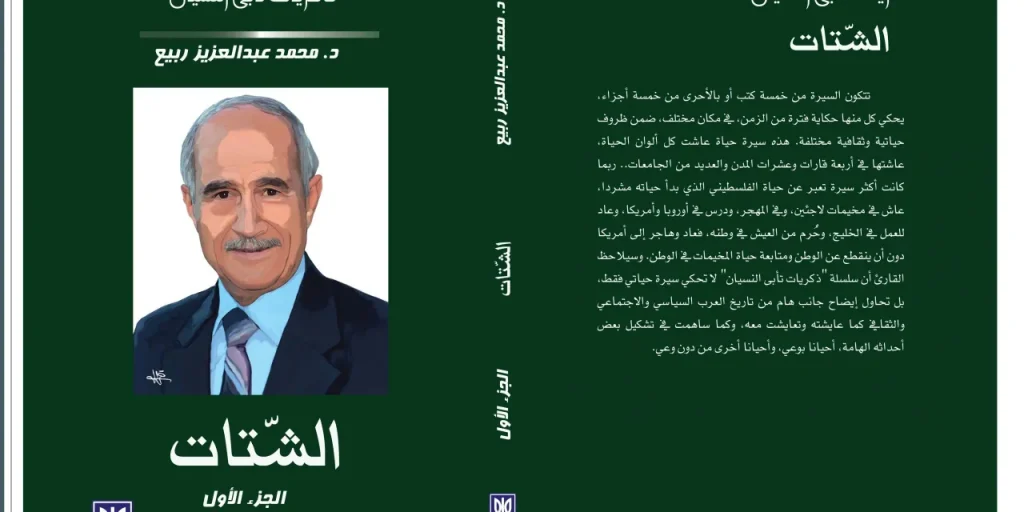
The fifth episode: the book (Memories that Refuse to Forget) by Dr. Muhammad Rabi`
One of the selections of Nazik Damra
in his book Memories that refuse to be forgotten, in which Muhammad Rabi’ discusses the memories of his childhood and the lives of his family and the people of his town in Yazour, a village rich in its wealth and the innovations of its people, which was located near the city of Jaffa, the bride of the Sea of Palestine, and what happened after that to his family and the people of his country Yazur and the Palestinians in general from the displacement torture and deprivation of safe settlement in their homes and property in Palestine.
My paternal grandfather and my maternal grandfather died years before my birth and my older sister’s birth, so my father lost his father at a young age, which made him yearn for that and treat every man older than him as his father. Because of the need of the slave Abu Rabi` for continuous assistance to take care of the grove, and in light of my uncle’s preoccupation with youth activities that have nothing to do with agriculture, such as acting, sports and cars, my father found himself in dire need of someone to help him on a permanent basis. He found what he was looking for in a sincere, kind-hearted man who was several years older than him from the village of Wadi Hanin, the village located to the south of the village of Beit Dajan. My father used to call the man who lived with us and in our house “Yapa,” meaning my father, and he would be kind and respectful to him, even when he made a mistake. One day, that man took me with him to his village on a donkey to attend the wedding of one of his eight children. However, the next morning I fled from the village and walked quickly in the direction of Yazur, where I followed the same road that we took from Yazur through Beit Dajan to Wadi Hanin, but one of his sons mounted his horse and followed me. While I was sitting on the roundabout of Beit Dajan, watching the passers-by and taking a break, this young man came to me and carried me on his horse, and we returned to Wadi Hanin. There was a joke saying: “If the people of Yazour get confused, the people of Beit Dajan will hear them.” This means that the residents of Beit Dajan hear the whispering of the residents of Yazur, due to the extreme proximity of Yazur to Beit Dajan. However, the close distances between the two villages, and the relations of lineage, neighborhood and friendship that linked the people of the two towns with strong bonds, were not sufficient to unify their dialects or their customs and traditions. The people of Beit Dajan were more socially liberated than the people of Yazour, and their dialect was softer, stretching the words as if they were chewing them. As for the people of Yazur, they were more solid and tolerant of others, which made Yazur host many strangers who came to live, work and trade in the city of Jaffa.
That kind sheikh whom I used to call “sir,” meaning my grandfather, was not the only person who joined our little family in Yazur and became one of us. There was also another person named Faris, who came as a boy from the village of “Beit Daras”, which is located in southern Palestine, about 30 kilometers from Gaza City. Rabi`, but his real name is Fares Mahmoud Khalil Shaheen. Because he was one of the family’s children, and he was not treated as an agricultural worker, my father married him to the daughter of his aunt, who was from the people of Qalqilya. As I learned, the cousin still lives with her children and grandchildren today in Amman, like the other sons of Yazour. When I opened my eyes to the world, I found a beautiful brunette woman around me. I loved her very much and she loved me more. I used to call her until her death in Amman after more than 60 years, my aunt Halima. As for the people of the town, they used to call it “Halima the Bedouin.”
The girl Halima came to Yazur after a long and arduous journey, we do not know how long it took, during which she crossed the Jordan River, several cities and dozens of Palestinian villages, and about 80 kilometers on foot. Halima, who belongs to the Al-Adwan clan, who lives in the Jordan Valley region on the eastern side of the Jordan River, had fled her homeland, her family’s home, and her clan’s clubs after she was exposed to unusual circumstances. Halima crossed the river and crossed to the West Bank, that is, to Palestine, and reached Yazur after a long journey, the details of which we do not know anything about. But when she arrived at Yazour, and she was pregnant at the time, she was lucky to find my grandmother, Hasan, there to receive her. My grandmother took her home and adopted her, took her into her little family, and treated her as her own daughter, until Hajja’s death in 1976 in Saudi Arabia. My grandmother apparently felt a psychological need for a daughter after fate deprived her of being the mother of a daughter of her own flesh and blood. My grandmother gave birth to more than ten sons and daughters, of whom only two survived, my father Abdel Aziz and my uncle Jumaa. And if “Faris Abu Rabi’” got his nickname as a result of my father joining him in our family, then “Halima Al-Badawi” got our family name in the official records after my sister and her brother adopted her, my father and my uncle. Aunt Halima married more than once, but she did not give birth to a son or a girl, even the fetus that she carried with her from Jordan, which was apparently the reason for her refuge in Palestine, died before he was born. The first marriage took place, with the help of my father, to a businessman who worked in commerce. He came to Jaffa from the village of Dora near Hebron, and he lived in “Abu Kabir Residence” in Jaffa. In the house of my aunt Halima and her husband, Abu al-Abed, I spent many nights and beautiful days, accompanying my aunt to the Jaffa market and its charming sea and beaches. And if “Faris Abu Rabi’” got his nickname as a result of my father joining him in our family, then “Halima Al-Badawi” got our family name in the official records after my sister and her brother adopted her, my father and my uncle. Aunt Halima married more than once, but she did not give birth to a son or a girl, even the fetus that she carried with her from Jordan, which was apparently the reason for her refuge in Palestine, died before he was born. The first marriage took place, with the help of my father, to a businessman who worked in commerce. He came to Jaffa from the village of Dora near Hebron, and he lived in “Abu Kabir Residence” in Jaffa. In the house of my aunt Halima and her husband, Abu al-Abed, I spent many nights and beautiful days, accompanying my aunt to the Jaffa market and its charming sea and beaches. And if “Faris Abu Rabi’” got his nickname as a result of my father joining him in our family, then “Halima Al-Badawiyyah” got our family name in the official records after my sister and her brother adopted her, my father and my uncle. Aunt Halima married more than once, but she did not give birth to a son or a girl, even the fetus that she carried with her from Jordan, which was apparently the reason for her refuge in Palestine, died before he was born. The first marriage took place, with the help of my father, to a businessman who worked in commerce. He came to Jaffa from the village of Dora near Hebron, and he lived in “Abu Kabir Residence” in Jaffa. In the house of my aunt Halima and her husband, Abu al-Abed, I spent many nights and beautiful days, accompanying my aunt to the Jaffa market and its charming sea and beaches. The first marriage took place, with the help of my father, to a businessman who worked in commerce. He came to Jaffa from the village of Dora near Hebron, and he lived in “Abu Kabir Residence” in Jaffa. In the house of my aunt Halima and her husband, Abu al-Abed, I spent many nights and beautiful days, accompanying my aunt to the Jaffa market and its charming sea and beaches. The first marriage took place, with the help of my father, to a businessman who worked in commerce. He came to Jaffa from the village of Dora near Hebron, and he lived in “Abu Kabir Residence” in Jaffa. In the house of my aunt Halima and her husband, Abu al-Abed, I spent many nights and beautiful days, accompanying my aunt to the Jaffa market and its charming sea and beaches.
My father taught me how to put my fingers in my mouth and whistle multiple notes, which we used as a means of communication between us. The single whistle meant “I am here”, while the two whistles meant “come”, and repeating it three times meant “don’t come, I will come”. So, after I woke up in the morning, and after I came back from school at noon, I would blow my whistle loudly and my father would answer me, and thus I would know his whereabouts in the grove. I go to him quickly, and he tells me about the things that I used to love and follow with passion: Bird houses that have begun to form, the number of eggs in the newly built houses, and what kind of birds are these? What is the size of the birds that were eggs and hatched a few days ago? And did it fly? That is, did she sleep enough and abandon her homes and travel with other birds over distances? Birds, their life story, types, colors, melodies, seasons of arrival and migration, were the most attractive things to me in my childhood, until that childhood stopped growing in the first month of 1948, and I was deprived of tasting the taste of joy and the enjoyment of hearing the prayers of birds receiving the morning, and bidding farewell to the day in the evening. The hoopoe was the bird that charmed me the most with its feathers, its beautiful colors, and its pride, and that is why I was so sad to leave it. Despite my love for sparrows and birds, my relationship with them was not only a relationship of love and adoration, but also a relationship of competition.
There are two negative experiences that occurred in front of me and had a great positive impact on my life: the first was that cigarette smoke was blown into my eyes, as that event made me hate cigarettes and smoking very much, and led me to take an anti-smoking stance in general… a position that was entrenched after science learned about the many health harms And dangerous for a cigarette. Therefore, I have never smoked a single cigarette in my life, and I refused all my father’s entreaties to buy him some packs of cigarettes from the plane when I was going to visit them in Amman during my work at Kuwait University. My father had learned to smoke after the catastrophe of 1948, and he did not quit until 1978, thirty years later. As for the second bad thing that had a positive impact on my life, it happened in Jericho, years later, when I saw a man who had lost consciousness from too much alcohol on one of the holidays, and began to stagger in a funny way, which prompted many boys and young men to gather around him and mock him. Since this man could not stand on his feet because of the excessive drunkenness, the security men put him in one of the iron wagons that were used to collect rubbish and rubbish from the streets and transport them to the incinerator. However, the man who at the time was among the imbeciles, thought himself a king or head of state riding in a luxury convertible car, and the crowds that gathered around him mocking him came to salute him and cheer for his life, which made him wave his hand saluting the masses on both sides of the road. This convinced me to stay away from alcohol and beware of the consequences of falling into the same predicament, and so I did not drift with my young friends later behind cigarettes or drinking alcohol, or even addiction to something related to eating, drinking or having fun… Yes, I was addicted to many hobbies, including love People, reading, writing, nature, travel and university teaching. However, the man who at the time was among the imbeciles, thought himself a king or head of state riding in a luxury convertible car, and the crowds that gathered around him mocking him came to salute him and cheer for his life, which made him wave his hand saluting the masses on both sides of the road. This convinced me to stay away from alcohol and beware of the consequences of falling into the same predicament, and so I did not drift with my young friends later behind cigarettes or drinking alcohol, or even addiction to something related to eating, drinking or having fun… Yes, I was addicted to many hobbies, including love People, reading, writing, nature, travel and university teaching. However, the man who at the time was among the imbeciles, thought himself a king or head of state riding in a luxury convertible car, and the crowds that gathered around him mocking him came to salute him and cheer for his life, which made him wave his hand saluting the masses on both sides of the road. This convinced me to stay away from alcohol and beware of the consequences of falling into the same predicament, and so I did not drift with my young friends later behind cigarettes or drinking alcohol, or even addiction to something related to eating, drinking or having fun… Yes, I was addicted to many hobbies, including love People, reading, writing, nature, travel and university teaching.
The fifth episode: the book (Memories that Refuse to Forget) by Dr. Muhammad Rabi`
One of the selections of Nazik Damra
in his book Memories that refuse to be forgotten, in which Muhammad Rabi’ discusses the memories of his childhood and the lives of his family and the people of his town in Yazour, a village rich in its wealth and the innovations of its people, which was located near the city of Jaffa, the bride of the Sea of Palestine, and what happened after that to his family and the people of his country Yazur and the Palestinians in general from the displacement torture and deprivation of safe settlement in their homes and property in Palestine.
My paternal grandfather and my maternal grandfather died years before my birth and my older sister’s birth, so my father lost his father at a young age, which made him yearn for that and treat every man older than him as his father. Because of the need of the slave Abu Rabi` for continuous assistance to take care of the grove, and in light of my uncle’s preoccupation with youth activities that have nothing to do with agriculture, such as acting, sports and cars, my father found himself in dire need of someone to help him on a permanent basis. He found what he was looking for in a sincere, kind-hearted man who was several years older than him from the village of Wadi Hanin, the village located to the south of the village of Beit Dajan. My father used to call the man who lived with us and in our house “Yapa,” meaning my father, and he would be kind and respectful to him, even when he made a mistake. One day, that man took me with him to his village on a donkey to attend the wedding of one of his eight children. However, the next morning I fled from the village and walked quickly in the direction of Yazur, where I followed the same road that we took from Yazur through Beit Dajan to Wadi Hanin, but one of his sons mounted his horse and followed me. While I was sitting on the roundabout of Beit Dajan, watching the passers-by and taking a break, this young man came to me and carried me on his horse, and we returned to Wadi Hanin. There was a joke saying: “If the people of Yazour get confused, the people of Beit Dajan will hear them.” This means that the residents of Beit Dajan hear the whispering of the residents of Yazur, due to the extreme proximity of Yazur to Beit Dajan. However, the close distances between the two villages, and the relations of lineage, neighborhood and friendship that linked the people of the two towns with strong bonds, were not sufficient to unify their dialects or their customs and traditions. The people of Beit Dajan were more socially liberated than the people of Yazour, and their dialect was softer, stretching the words as if they were chewing them. As for the people of Yazur, they were more solid and tolerant of others, which made Yazur host many strangers who came to live, work and trade in the city of Jaffa.
That kind sheikh whom I used to call “sir,” meaning my grandfather, was not the only person who joined our little family in Yazur and became one of us. There was also another person named Faris, who came as a boy from the village of “Beit Daras”, which is located in southern Palestine, about 30 kilometers from Gaza City. Rabi`, but his real name is Fares Mahmoud Khalil Shaheen. Because he was one of the family’s children, and he was not treated as an agricultural worker, my father married him to the daughter of his aunt, who was from the people of Qalqilya. As I learned, the cousin still lives with her children and grandchildren today in Amman, like the other sons of Yazour. When I opened my eyes to the world, I found a beautiful brunette woman around me. I loved her very much and she loved me more. I used to call her until her death in Amman after more than 60 years, my aunt Halima. As for the people of the town, they used to call it “Halima the Bedouin.”
The girl Halima came to Yazur after a long and arduous journey, we do not know how long it took, during which she crossed the Jordan River, several cities and dozens of Palestinian villages, and about 80 kilometers on foot. Halima, who belongs to the Al-Adwan clan, who lives in the Jordan Valley region on the eastern side of the Jordan River, had fled her homeland, her family’s home, and her clan’s clubs after she was exposed to unusual circumstances. Halima crossed the river and crossed to the West Bank, that is, to Palestine, and reached Yazur after a long journey, the details of which we do not know anything about. But when she arrived at Yazour, and she was pregnant at the time, she was lucky to find my grandmother, Hasan, there to receive her. My grandmother took her home and adopted her, took her into her little family, and treated her as her own daughter, until Hajja’s death in 1976 in Saudi Arabia. My grandmother apparently felt a psychological need for a daughter after fate deprived her of being the mother of a daughter of her own flesh and blood. My grandmother gave birth to more than ten sons and daughters, of whom only two survived, my father Abdel Aziz and my uncle Jumaa. And if “Faris Abu Rabi’” got his nickname as a result of my father joining him in our family, then “Halima Al-Badawi” got our family name in the official records after my sister and her brother adopted her, my father and my uncle. Aunt Halima married more than once, but she did not give birth to a son or a girl, even the fetus that she carried with her from Jordan, which was apparently the reason for her refuge in Palestine, died before he was born. The first marriage took place, with the help of my father, to a businessman who worked in commerce. He came to Jaffa from the village of Dora near Hebron, and he lived in “Abu Kabir Residence” in Jaffa. In the house of my aunt Halima and her husband, Abu al-Abed, I spent many nights and beautiful days, accompanying my aunt to the Jaffa market and its charming sea and beaches. And if “Faris Abu Rabi’” got his nickname as a result of my father joining him in our family, then “Halima Al-Badawi” got our family name in the official records after my sister and her brother adopted her, my father and my uncle. Aunt Halima married more than once, but she did not give birth to a son or a girl, even the fetus that she carried with her from Jordan, which was apparently the reason for her refuge in Palestine, died before he was born. The first marriage took place, with the help of my father, to a businessman who worked in commerce. He came to Jaffa from the village of Dora near Hebron, and he lived in “Abu Kabir Residence” in Jaffa. In the house of my aunt Halima and her husband, Abu al-Abed, I spent many nights and beautiful days, accompanying my aunt to the Jaffa market and its charming sea and beaches. And if “Faris Abu Rabi’” got his nickname as a result of my father joining him in our family, then “Halima Al-Badawiyyah” got our family name in the official records after my sister and her brother adopted her, my father and my uncle. Aunt Halima married more than once, but she did not give birth to a son or a girl, even the fetus that she carried with her from Jordan, which was apparently the reason for her refuge in Palestine, died before he was born. The first marriage took place, with the help of my father, to a businessman who worked in commerce. He came to Jaffa from the village of Dora near Hebron, and he lived in “Abu Kabir Residence” in Jaffa. In the house of my aunt Halima and her husband, Abu al-Abed, I spent many nights and beautiful days, accompanying my aunt to the Jaffa market and its charming sea and beaches. The first marriage took place, with the help of my father, to a businessman who worked in commerce. He came to Jaffa from the village of Dora near Hebron, and he lived in “Abu Kabir Residence” in Jaffa. In the house of my aunt Halima and her husband, Abu al-Abed, I spent many nights and beautiful days, accompanying my aunt to the Jaffa market and its charming sea and beaches. The first marriage took place, with the help of my father, to a businessman who worked in commerce. He came to Jaffa from the village of Dora near Hebron, and he lived in “Abu Kabir Residence” in Jaffa. In the house of my aunt Halima and her husband, Abu al-Abed, I spent many nights and beautiful days, accompanying my aunt to the Jaffa market and its charming sea and beaches.
My father taught me how to put my fingers in my mouth and whistle multiple notes, which we used as a means of communication between us. The single whistle meant “I am here”, while the two whistles meant “come”, and repeating it three times meant “don’t come, I will come”. So, after I woke up in the morning, and after I came back from school at noon, I would blow my whistle loudly and my father would answer me, and thus I would know his whereabouts in the grove. I go to him quickly, and he tells me about the things that I used to love and follow with passion: Bird houses that have begun to form, the number of eggs in the newly built houses, and what kind of birds are these? What is the size of the birds that were eggs and hatched a few days ago? And did it fly? That is, did she sleep enough and abandon her homes and travel with other birds over distances? Birds, their life story, types, colors, melodies, seasons of arrival and migration, were the most attractive things to me in my childhood, until that childhood stopped growing in the first month of 1948, and I was deprived of tasting the taste of joy and the enjoyment of hearing the prayers of birds receiving the morning, and bidding farewell to the day in the evening. The hoopoe was the bird that charmed me the most with its feathers, its beautiful colors, and its pride, and that is why I was so sad to leave it. Despite my love for sparrows and birds, my relationship with them was not only a relationship of love and adoration, but also a relationship of competition.
There are two negative experiences that occurred in front of me and had a great positive impact on my life: the first was that cigarette smoke was blown into my eyes, as that event made me hate cigarettes and smoking very much, and led me to take an anti-smoking stance in general… a position that was entrenched after science learned about the many health harms And dangerous for a cigarette. Therefore, I have never smoked a single cigarette in my life, and I refused all my father’s entreaties to buy him some packs of cigarettes from the plane when I was going to visit them in Amman during my work at Kuwait University. My father had learned to smoke after the catastrophe of 1948, and he did not quit until 1978, thirty years later. As for the second bad thing that had a positive impact on my life, it happened in Jericho, years later, when I saw a man who had lost consciousness from too much alcohol on one of the holidays, and began to stagger in a funny way, which prompted many boys and young men to gather around him and mock him. Since this man could not stand on his feet because of the excessive drunkenness, the security men put him in one of the iron wagons that were used to collect rubbish and rubbish from the streets and transport them to the incinerator. However, the man who at the time was among the imbeciles, thought himself a king or head of state riding in a luxury convertible car, and the crowds that gathered around him mocking him came to salute him and cheer for his life, which made him wave his hand saluting the masses on both sides of the road. This convinced me to stay away from alcohol and beware of the consequences of falling into the same predicament, and so I did not drift with my young friends later behind cigarettes or drinking alcohol, or even addiction to something related to eating, drinking or having fun… Yes, I was addicted to many hobbies, including love People, reading, writing, nature, travel and university teaching. However, the man who at the time was among the imbeciles, thought himself a king or head of state riding in a luxury convertible car, and the crowds that gathered around him mocking him came to salute him and cheer for his life, which made him wave his hand saluting the masses on both sides of the road. This convinced me to stay away from alcohol and beware of the consequences of falling into the same predicament, and so I did not drift with my young friends later behind cigarettes or drinking alcohol, or even addiction to something related to eating, drinking or having fun… Yes, I was addicted to many hobbies, including love People, reading, writing, nature, travel and university teaching. However, the man who at the time was among the imbeciles, thought himself a king or head of state riding in a luxury convertible car, and the crowds that gathered around him mocking him came to salute him and cheer for his life, which made him wave his hand saluting the masses on both sides of the road. This convinced me to stay away from alcohol and beware of the consequences of falling into the same predicament, and so I did not drift with my young friends later behind cigarettes or drinking alcohol, or even addiction to something related to eating, drinking or having fun… Yes, I was addicted to many hobbies, including love People, reading, writing, nature, travel and university teaching.